



Given the current dynamics at play, many companies have no choice but to further localize their value-added activities in China. The Chamber of Industry and Commerce (IHK) refers to this as “Localization 3.0.”
Key forces drive localization
The figure illustrates the key factors influencing localization in China:
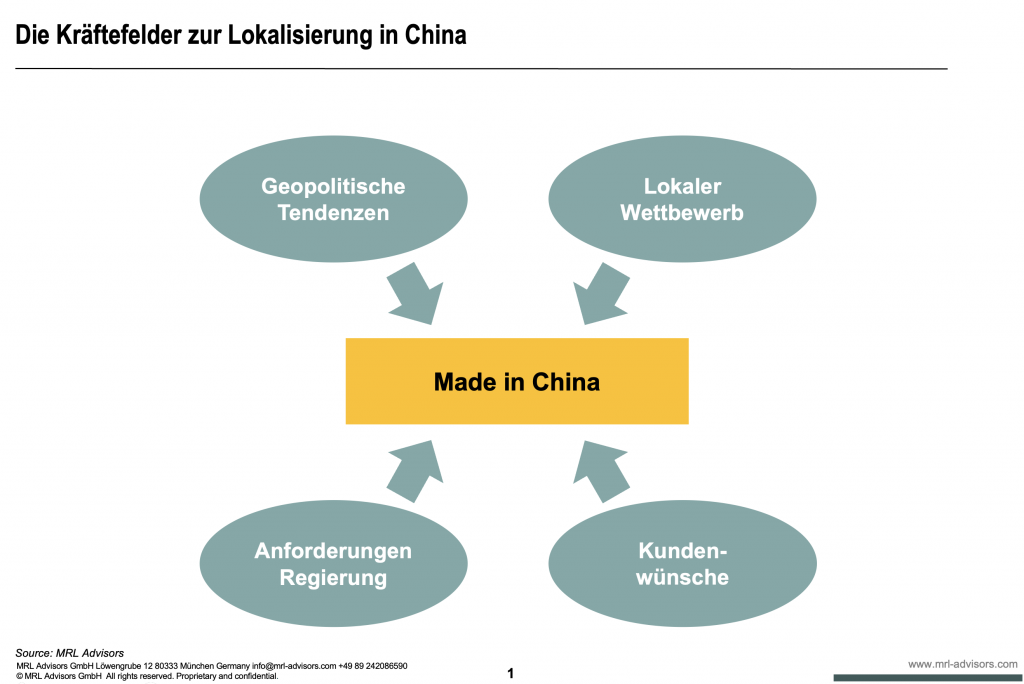
The fields appear to be interdependent because:
- As Chinese companies have become more competitive, the “Made in China” label has become easier for all companies to promote
- Geopolitical trends are leading to further efforts toward autonomy—in other words, “Made in China”
- Regulatory requirements regarding local content can be effectively met thanks to the increased capabilities of Chinese companies.
For example, in the pharmaceutical and medical technology industries, “Volume-Based Procurement (VBP)” is mandatory in many areas. Under this system, volume-based prices are negotiated—in some cases for the annual needs of entire provinces—which drastically reduce the once-generous margins but also eliminate distribution tiers. Starting with the pharmaceutical industry—and increasingly evident in medical technology as well—local production is mandated in the relevant tenders. Companies such as the Swiss firm Straumann AG recognized this trend early on and are focusing on production in China—for the Chinese market.

Opportunities for Localization in China
Localizing production and R&D not only entails risks but, above all, presents opportunities: Greater proximity to customers and products and solutions tailored to customer needs can lead to even greater success in China. Furthermore, only through greater localization can companies effectively respond to the highly dynamic market in China. Experience gained in China, in turn, can be very useful in other parts of the world.
“China is the fitness center for our company. We’re moving at ‘China speed.'”
(R. Holdmann, ZF Executive Board Member, Handelsblatt, July 11, 2025) )
The same was true for VW: to accelerate development in the short term, a partnership with a local Chinese company was necessary. Meanwhile, thanks to the experience gained in China, development times in Europe have also been reduced from 48 to 30 to 36 months. (Interview with R. Brandstätter, VW Executive Board member, quoted in Handelsblatt on July 15, 2025).
Exports from China
Exports from Chinese production also hold great potential: not so much to Europe or the U.S., but rather to countries that cooperate more closely with China (e.g., Belt and Road, Southeast Asia).
Financing
When financing the localization, the option of using local capital sources should be considered—for example, by partnering with a local investor who covers the necessary investment from their capital contribution.
However, MRL Advisors continues to recommend that the IP owner (i.e., the core European company) should always ensure that it retains ultimate control over activities in China—without running the risk of even a stalemate.
Further information is available to interested companies at MRL Advisors .